Showing posts with label Daily Poem. Show all posts

Thursday, 1 April 2010

daily poem: Wet Evening in April / Patrick Kavanagh


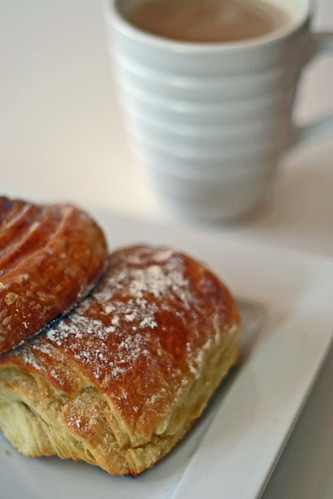
Trust National Poetry Month to happen at the same time as ScriptFrenzy (30 days, 100 pages, yiiikes), it's going to be a busy (and fun) few weeks! You'll be able to follow my ScriptFrenzy progress over at my film blog The Usherette, from April 2nd onwards, when I'll be living deadline free for a wee while at least! So, here's a little gem from Patrick Kavanagh to start off our poetical April, and very appropriate it is - as I type blustery wind and April showers are rattling the windowpanes, time to get under the duvet with a mug of something piping hot and chocolatey...


Wet Evening in April
Patrick Kavanagh

The birds sang in the wet trees
And as I listened to them it was a hundred years from now
And I was dead and someone else was listening to them.
But I was glad I had recorded for him
The melancholy.


Photo by Bator Horvath

Wednesday, 31 March 2010

daily poem: The Howling of Wolves / Ted Hughes


Apologies for lack of blogage this week, have been away from home for the last few days gorging on easter eggs and gin-&-tonics at the boyfriend's place in darkest Argyll. Am up late translating Old English poetry for a freelance research gig, deadline tomorrow - why am I still totally unable to do academic work unless I'm looking down the barrell of a deadline?

The Portmanteau is due a couple of big juicy posts this week, in the meantime here's something for a dark and stormy night from Ted Hughes...


The Howling of Wolves
Ted Hughes

Is without world.

What are they dragging up and out on their long leashes of sound

That dissolve in the mid-air silence?

Then crying of a baby, in this forest of starving silences,
Brings the wolves running.
Tuning of a violin, in this forest delicate as an owl’s ear,
Brings the wolves running—brings the steel traps clashing and slavering,
The steel furred to keep it from cracking in the cold,
The eyes that never learn how it has come about
That they must live like this,

That they must live

Innocence crept into minerals.

The wind sweeps through and the hunched wolf shivers.
It howls you cannot say whether out of agony or joy.

The earth is under its tongue,
A dead weight of darkness, trying to see through its eyes.
The wolf is living for the earth.
But the wolf is small, it comprehends little.

It goes to and fro, trailing its haunches and whimpering horribly.

It must feed its fur.

The night snows stars and the earth creaks.


Photo by Me.

Wednesday, 24 March 2010

daily poem: Always, Sweetness / Pablo Neruda


I'm finding writing in the kitchen quite inspiring today, consequently The Portmanteau has been serving poems for the ravenous, sensory poems that play on the way language tastes on your tongue, food for thought, words that slake thirst and satisfy hunger. "Poetry," says Lucille Clifton, "speaks to something in us that so wants to be filled. It speaks to the great hunger of the soul."

Here's a wonderful poem from Pablo Neruda, good enough to eat.


Always, Sweetness
Pablo Neruda

Why such harsh machinery?
Why, to write down the stuff and people of everyday,
must poems be dressed up in gold,
or in old and fearful stone?

I want verses of felt or feather
which scarcely weigh, mild verses
with the intimacy of beds
where people have loved and dreamed.
I want poems stained
by hands and everydayness.

Verses of pastry which melt
into milk and sugar in the mouth,
air and water to drink,
the bites and kisses of love.
I long for eatable sonnets,
poems of honey and flour.

Vanity keeps prodding us
to lift ourselves skyward
or to make deep and useless
tunnels underground.
So we forget the joyous
love-needs of our bodies.
We forget about pastries.
We are not feeding the world.

In Madras a long time since,
I saw a sugary pyramid,
a tower of confectionery -
one level after another,
and in the construction, rubies,
and other blushing delights,
medieval and yellow.

Someone dirtied his hands
to cook up so much sweetness.

Brother poets from here
and there, from earth and sky,
from Medellin, from Veracruz,
Abyssinia, Antofagasta,
do you know the recipe for honeycombs?

Let’s forget about all that stone.

Let your poetry fill up
the equinoctial pastry shop
our mouths long to devour -
all the children’s mouths
and the poor adults’ also.
Don’t go on without seeing,
relishing, understanding
all these hearts of sugar.

Don’t be afraid of sweetness.

With or without us,
sweetness will go on living
and is infinitely alive,
forever being revived,
for it’s in a man’s mouth,
whether he’s eating or singing,
that sweetness has its place.

Translated from the Spanish by Alastair Reid


Read more Pablo Neruda here. // Buy The Essential Neruda here.

Photo by Veronika Lake

Saturday, 6 March 2010

daily poem: The Promise / Sharon Olds


Having a rather bad day today, trying to focus on the positive in the spirit of TiLT, but feeling a little overwhelmed by a recent spate of personal disappointments and bad news. However it's only Day Two of The Portmanteau's Poetry Month and I don't want to fall behind already...so here's a poem from Sharon Olds for the moment. I was hoping to focus on Olds in today's poet profile too, but I think I'll keep that for next week when I have more time to do her justice. In the meantime I'm planning to get a profile post on Elizabeth Bishop (who I can write about more easily, having studied her in some depth as an undergrad) and some audio up tonight. Here's 'The Promise', which I adore, in fact I'm completely head-over-heels for Sharon Olds, no one writes about love and sex with such tenderness and richness and lyricism as she does...


The Promise
Sharon Olds

With the second drink, at the restaurant,
holding hands on the bare table,
we are at it again, renewing our promise
to kill each other. You are drinking gin,
night-blue juniper berry
dissolving in your body, I am drinking Fumé,
chewing its fragrant dirt and smoke, we are
taking on earth, we are part soil already,
and wherever we are, we are also in our
bed, fitted, naked, closely
along each other, half passed out,
after love, drifting back
and forth across the border of consciousness,
our bodies buoyant, clasped. Your hand
tightens on the table. You’re a little afraid
I’ll chicken out. What you do not want
is to lie in a hospital bed for a year
after a stroke, without being able
to think or die, you do not want
to be tied to a chair like your prim grandmother,
cursing. The room is dim around us,
ivory globes, pink curtains
bound at the waist—and outside,
a weightless, luminous, lifted-up
summer twilight. I tell you you do not
know me if you think I will not
kill you. Think how we have floated together
eye to eye, nipple to nipple,
sex to sex, the halves of a creature
drifting up to the lip of matter
and over it—you know me from the bright, blood-
flecked delivery room, if a lion
had you in its jaws I would attack it, if the ropes
binding your soul are your own wrists, I will cut them.


From Strike Sparks: Selected Poems 1980-2002. Buy it here.

Photo by koinis.

Friday, 19 February 2010

daily poem: Introduction to Poetry / Billy Collins


I love Billy Collins, one of those rare genuinely popular poets who has a real evangelistic approach to poetry, and who manages to be funny and lyrical and very accessible. His brilliant Poetry 180 project is all about getting poetry-for-pleasure into the classroom, with a hand-picked collection of 180 poems - one for every day of the school year - selected on the basis of “their willingness to deliver immediate injections of pleasure.” It's also a great introduction to contemporary poets, including many not especially famous. You can read the poems over here and there's a handy teacher's guide here.


Introduction to Poetry
Billy Collins

I ask them to take a poem
and hold it up to the light
like a colour slide

or press an ear against its hive.

I say drop a mouse into a poem
and watch him probe his way out,

or walk inside the poem’s room
And feel the walls for a light switch.

I want them to waterski
across the surface of a poem
waving at the author’s name on the shore.

But all they want to do
is tie the poem to a chair with rope
and torture a confession out of it.

They begin beating it with a hose
to find out what it really means.


Buy Poetry 180 here. // Buy 180 More here.

Photo by marrian.